Working Blues

Monday, August 21, 2006

From One Tree Hill…

"Everyday is A Sunday Evening"

"You know that feeling you get on a Sunday? When you just have the whole day to yourself, and it's been great, but then you remember you have to go to school the next day, and it ruins the whole rest of the night.”

I never really had a problem about having to go to school but this is exactly what I feel most of the time towards work.

Feel ko lang...

Sunday, August 20, 2006

In my Must Do List right now is WALL / ROCK CLIMBING. I don’t think I have the upper body strength but what the heck, I still want to try it out.

As opposed to my Dec 15, 2004 post, which I’m still bent on accomplishing someday – kahit isa man lang, this one is something that is more doable and possible. But first, I need to find a willing person. Di ko ata kaya ng mag-isa, hehe.

O Nga Naman...

Friday, August 18, 2006


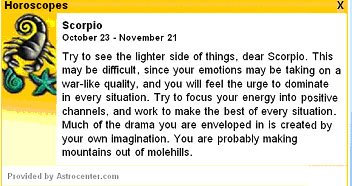
My horoscope for today seems to have hit the bull's eye. Maybe it isn't as bad as I'm "believing" it to be. I probably am making mountains out of molehills. Point well taken.

Kebs AKo

Tuesday, August 01, 2006

While I was walking the aisles of Fully Booked a couple of weeks ago, one of the books that caught my eye was Lois P. Frankel's Nice Girls Don't Get The Corner Office 101 - Unconscious Mistakes Women Make That Sabotage Their Careers. Unfortunately as it turned out, this book seems to be describing most of the supposedly "wrong" things that I'm unconsciously doing at work. Read: If you work nonstop without a break...worry about offending others and back down too easily...explain too much when asked for information...or "poll" your friends and colleagues before making a decision, chances are you have been bypassed for promotions and ignored when you expressed your ideas. Although you may not be aware of it, girlish behaviors such as these are sabotaging your career!

Sometimes being nice just isn't enough anymore. It's not that I have to exert effort to be nice. What can I do if everything is really honest to goodness okay for me? I really don't see any reason to complicate things any further or make things difficult for others. For as long as it's something that I can do and I'm comfortable with, I'd be more than willing to help or share. It just takes a whole lot to piss me off. My patience can stretch the mile when it comes to dealing with difficult and/or stupid people. I can shrug at crappy insensitive jokes all in the name of "fun" or camaraderie. Really, I don't get irritated easily. I can't even remember the last time I was fuming mad. Ganun lang talaga ako, I guess.

However, a recent experience at work has made me come to the realization that nice girls always finish last. Being nice doesn't cut it anymore. Henceforth, I've resolved to consciously exert more effort not to be nice at work. Even if it's really okay, it's no longer going to be okay anymore. I'm not going to be as considerate anymore. After all, most people aren't really that considerate anyway. Bastusan na kung bastusan basta I'm going to be "kebs" about everything at work - a term I'm borrowing from my sister, a term she uses for I don't care or I couldn't care less or wala akong pakialam. So kebs na ako if I'm on the bad side of my boss. Kebs ako if I piss her off because of some mistake I made. Kebs ako if I always come in the office last (hello, everyone in my tiny department comes in on average at least 30mins earlier!). Kebs ako if I always leave the office first (hello, try working in a tiny department where on average everyone leaves way past dinner time). Kebs ako if iba ang trip ko sa mga officemates ko. Kebs ako if I don't do the usual things that my officemates do. Kebs ako if I'm out of the loop. Kebs ako if I'm not the best employee. Kebs ako sa lahat - n.r., walang pakialam, don't care.

The Why Are You Still Single Test

Sunday, July 23, 2006

Candice, you're single because you don't want to slow down...

Whether you're working all hours, busy with school, or planning a cross-country move, it sounds like you just don't have time for anyone else in your life...right now, that is. Your timing may be off in other aspects, too. Chances are, you've met that perfect person who just so happens to be married (ed. or attached) or planning their own cross-country move. So take a step back for a moment. Is there something underlying this?

Could it be you're afraid to get involved for some reason or another, and are therefore attracted to people who are simply unavailable? Whether you're secretly sabotaging yourself or not, try a little exercise. Open your mind to those who are around you (and available!) right now. Then let up on your schedule to let that someone in. That is, unless you want to get married to your goals, and not Mr. or Mrs. Right.

Omg, is this a sign? Interesting result - but definitely in a negative way. Actually, I wasn't really surprised anymore with the results of this test. In a way, subconsciously alam ko na rin and in denial nalang ako siguro. Maybe it's about time for me to reassess my situation and take a different approach naman or do something about it, I guess. This is one of those wake up calls that I have to make to thy self.

K.I.T.

Frustrating as it is, I think relationships are harder to keep as we grow older and as priorities start to change. Often, we busy and exhaust ourselves with work and other things that relationships start to take the back seat. I personally feel that it takes tons of effort to keep in touch on a regular basis especially if there's no everyday physical contact. Although communication is made easier with the help of modern technology, for me iba pa rin talaga kapag in person and face-to-face.

Despite the absence of constant and physical communication though, it's good to know that friendships have still remained intact. I honestly miss the good old days when we'd see each other everyday (in school). I miss the times when we'd get to talk to each other anytime or just hang out. I miss the jokes and kalokohans. It's really nice to have the feeling of familiarity and the closeness of their company. It's funny though how the experiences that we share are somehow on a more grown-up level now. It's strange how we've all suddenly grown into these so-called matured adults with a much more different take on life. As the general sentiment of this entry is about rekindling old friendships, the reason being because incidentally for the last two weekends, I met and caught up with a couple of friends from high school and college whom I haven't seen in ages. All were very pleasant dates. If only we could all squeeze in more time together and make this a regular thing and be part of all the changes in each other's lives.

On World Geography

Friday, July 14, 2006

Have you ever wondered how many countries are there in the world? I did. To satisfy my curiosity, I searched the ever so reliable world wide web for a solid answer.


By Most Accounts, 193 is the Correct Answer
A very frequent geographical question is "How many countries are in the world?." Different numbers pop up when one inquires or reads about the number of countries in the world. Each source you use often yields a different answer.

United Nations
There are 192 members of the United Nations. Unfortunately, the number 192 is too often used to represent the number of countries in the world. Although this number represents almost all of the countries in the world, there is still one country (the Vatican City) that is independent and has chosen not to become a member of the U.N. so 192 is not the number of countries in the world.

U.S. Department of State
The United States' State Department recognizes 193 independent countries around the world.

Their list of 193 countries reflects the political agenda of the United States of America and its allies. Missing from the State Department's list is one entity that may or may not be considered a country, depending on who you talk to.

The One Outsider
Taiwan meets most, but not all of the requirements of independent country or state status. However, due to political reasons, it fails to be recognized by the United States and much of the rest of the world. If it were recognized, it would be considered a country.

Taiwan was actually a member of the United Nations (and even the Security Council) until 1971, when mainland China replaced Taiwan in the organization. Taiwan continues to press for full recognition by other countries, to become "part of the club" and fully recognized worldwide but China claims that Taiwan is simply a province of China.

Thus...
Your Guide considers there to be 193 countries in the world, which is probably the best current answer to the question, "How many countries are in the world?" unless Taiwan becomes officially recognized by the international community, in which case the answer would be 194.

However...
Recognize that there are dozens of territories and colonies that are sometimes erroneously called "countries" but don't count at all - they're governed by other countries. Places commonly confused as being countries include Puerto Rico, Bermuda, Greenland, Palestine, Western Sahara, and even the components of the United Kingdom (such as Northern Ireland, Scotland, Wales, and England - sorry folks, they're not countries, states, or nation-states).

Hmmm...interesting.

The So-Called F Word

Sunday, July 09, 2006

I heard mass this morning and interestingly, I found today's homily very meaningful.

The officiating priest posed a question, what do you fear the most? What is your greatest fear?

According to the priest, a survey conudcted by Wall Street Journal to some random 10,000 people show that the three things that people fear the most are as follows: (3) death / kamatayan, (2) loneliness / kalungkutan and lastly, (1) failure / kabiguan.

For this entry though, I'd like to ponder on the fear of failure. Coincidentally, the fear of failure is something which I think I have been subconsciously worrying about all this time. Well actually, only since I started to make my way to the real world - the corporate world, that is. I mean, I knew I was often anxious or worried about something but I never really thought about it concretely or in this way. Well, not until now.

The priest said the quickest road to failure is as follows: to give up right away, self-pity and self-centeredness. And you know what, I couldn't agree more. Whoever said life is going to be easy anyway? We just need to keep the faith. We need to have a strong faith in ourselves and most importantly, in God.

Rather than giving my two cents worth on the given subject, here's an article I stumbled upon which says it all already and which I believe makes perfectly good sense. It's a little long but if you're currently in dire need of some source of inspiration then read on buddy! ;)

DEALING WITH SO-CALLED FAILURE
by Jeffery Combs

What makes the difference between ordinary and extraordinary, between average and excellent, mediocre and superb? Is it family background? Are achievers born into wealth? Is it better opportunities for certain people? Opportunity is a strange thing because two people with similar gifts, talents and resources can look at a situation and one person will see tremendous opportunity while the other is negative and skeptical. One man's junk is another man's jewel. Opportunity is like beauty. It's in the eye of the beholder.

Is achievement gained because of hardship or because of lack of hardship? Is it high morals or how about a great education? Perhaps here is the great secret. Well, I believe it is none of these items. The bottom line that separates those who achieve from those who don't is different perceptions and responses to what many people consider failure. Nothing else has such a dramatic impact on people's ability to achieve and to accomplish whatever they set out to accomplish. There are literally thousands of ways to become a winner and the sure way I know of to stay average is to fail and not investigate what you gained from the apparent failure. Through trial and error, I eventually taught myself how to view, what most people say is failure, differently. I taught myself that everything happens for a reason.

When a situation or a circumstance happens and it doesn't appear favorably for me at that moment, I have learned to detach, pull back, instead of over-reacting to the circumstances. By detaching, I'm talking about the thought process I now take now rather than the ones I used to take before. There are many situations you cannot change but you can definitely change how you view them, especially related to what most people perceive to be failure. I ask people all the time who say they've failed, I say, "Have you really? Did you really fail?" Then I ask them the next question - "What did you gain, who did you meet, how did it develop character, what happened because of the situation?"

I thoroughly believe that for every door that closes, a new window opens. I have seen many average people who have never had success in any other endeavors have fantastic success in direct sales, networking or in any kind of small business. I have also seen many people who have success in a corporate environment fail miserably as an entrepreneur. To a large extent, the reason the failure rate is so high in free enterprise is that we as a society are not prepared and not mentally conditioned to deal with the inevitable emotional roller coaster of entrepreneurship. We are taught through education, training, college, other schooling and on the job training to become good employees. We end up learning job skills, not the free thinking skills that lead to success as an entrepreneur. Most of all we are not taught how to look at our mistakes and failures properly. Once again, I believe there is no such thing as failure. Every blade of grass we walk upon brings us to this moment which is officially called now, the present, or officially now o'clock.

I have personally attended hundreds of seminars, rallies and conventions over the last several years and have heard the stories and testimonies of people who have succeeded. It often looks easy from the audience perspective to make a $10,000 per month check or have a $100,000 per year. I remember in my early career, seeing these people and saying to myself, that if they can do it, so can I. They are no different. That was true, except the difference between them and me was a few key points that I had to learn in the journey. Skills such as developing a belief, understanding how to market myself, how to be consistent, how to be self-motivated over time to create what is called compounding. Internal compounding is going to be the difference between average and exceptional. Internal compounding really begins with you becoming comfortable with yourself - becoming the person you deserve to be, really having a belief in yourself, a sense of certainty that no matter what obstacles, what roadblocks, what challenges, what hurdles arrive in your way, you begin to turn roadblocks into building blocks.

You're going to learn a different perception of challenges and overcoming them right now. Most important, with simple disciplines, learned, acquired and then diligently and consistently applied over a period of time, you start to release yourself from the attachment of what most people consider to be failure. Personal growth coupled with a plan of action. Diligent and consistent action to produce results not only in yourself, but with others, too. The heart of a champion, developing heart rather than just relying on your talent.

Do not compare yourself to others. You never know the price someone has paid to get to their promised land, and they did pay it at one time or another. Even the statement, "paying the price" is unusual. A good friend and motivational speaker once said to me, "Jeff, it's not a price, it's a privilege." Indeed, my friends that is a whole different perspective. Are you really paying a price or is it a privilege to be going through the process that you are going through? Most importantly, it is imperative that you start to view your past failures differently and change how you view challenges and obstacles that face you today and in the future.

One of the most common problems I see in free enterprise and entrepreneurship is that people quit too soon. Not only to do they quit too soon, they never even start and they often quit too easily and too often. They then go back to what already wasn't working for them, usually a job, and give up on their dreams. I have found that if you don't have dreams, you end up working for people who do. In a job, typically, you're creating someone else's dream and that's not to say that jobs are bad, but will you ever get your promised land, producing results for someone else in their dream? That is an interesting question. Success isn't always easy is it? And definitely not a sprint, it's a marathon. Most people quit in free enterprise in their first 90 days, six months or one year. This is a usual pattern for most people; they don't stay in the game long enough to learn the survival skills required to win the game of their life. They dabble, they give it a shot, they try, they wish, they hope, they'd like to, they think about it, they take little action, get their feelings hurt, test the water and, most of all, treat it like a hobby, then it costs them enough money, so they quit and say, "It didn't work for me" or "I got burned."

Free enterprise is about going through mind shifts, evolutions of new consciousness, getting out of the box, off the sidelines, in the game, playing offense rather than defense, learning life skills so that you can get paid what you are worth. It is the opportunity to win the game of life on your terms, in your time frame. Quitters never win and winners never quit. Winners learn how to fail more intelligently. Isn't it time you learned how to treat failure differently? Isn't it time you changed how you've been changing?